
Changing the Urban Metabolism
There is a growing consensus that towns and cities cannot continue to only receive resources; they will also have to produce the food and energy needed by their populations. In the future, these “hungry cities,” to use Carolyn Steel’s expression, could increasingly be fed with food from somewhere, that is, food produced a short distance from consumers through urban and peri-urban agriculture, instead of nowhere, as introduced by agro-industries into our European diets.[1] Scholars from a wide range of sciences dealing with climate change and urbanism have brought to the forefront how European cities have the space and potential to modify their metabolism with regards to food, that is, to reduce the incoming flows of foodstuffs required by their population.[2] Using open, available spaces — think rooftops, gardens, or vacant lots — one could produce up to 28 percent of the urban vegetable demand in Europe in the direct vicinity of its consumers.[3] It all sounds promising, especially given how energy-intensive vegetable production in greenhouses has become, from the Netherlands to Spain.[4] But can it be that simple?
Lesson Learned
As a historian who has spent the past couple of years studying urban agriculture, this assessment rang a couple of worrying bells: Who do scholars think will garden? With what time, money, or even knowledge? And who amongst the urban population will truly benefit from these shortened food chains? Researching the legacy of urban agriculture reminds us that present-day food systems have their roots in historical contexts — including their inequalities and power imbalances.[5]
Take fifteenth- and sixteenth-century Antwerp, a city in what is today Belgium. As Antwerp grew from a medium-sized town to a commercial metropolis, food entitlements from urban and peri-urban agriculture exacerbated inequalities rather than mitigated them, because only a handful of better-off dwellers could or would produce food in their courtyards. Often, those who needed it the least could have chosen between self-sufficiency and market purchases, while others simply remained at the whims of the market. The middling sort, in particular the craftspeople who had courtyards and back gardens, would have had to choose or keep a balance between using the space for their professional activity and food production. In the late fifteenth and early sixteenth century, commercial gardeners were increasingly regulating their profession and taking up space outside the city walls; yet they owned little of the ground they tilled, making horticulture profitable for their landlords, too.[6]
What is the lesson learned here? Land access determines food access. Whether one could enjoy the fruit of the land depended on the kind of land, its location, and, most importantly, the property rights. Stating that 28 percent of urban vegetable demand could be fulfilled by urban and peri-urban agriculture, in my opinion, leaves out this lesson and dismisses crucial questions: How will access to land and thus to local food be monitored? Who will own the space and who will get the harvest from it? If growing food becomes an additional household task, it will likely fall on female shoulders, as it has throughout history. The widespread deployment of urban agriculture in Europe requires looking at inequalities in access to space, time, and knowledge — not simply calculating the available space — if one is to avoid inheriting past negative aspects of vegetable production.
It May Not Be About the Food
Another takeaway from my time exploring the history of urban agriculture did not come from research, but from teaching and practice. Urban agriculture might become a nutritive component of city food systems, but right now, I think that it would be more relevant to consider its relationship to knowledge. Think about it: When was the last time you gardened? Do you remember when you should plant which kind of seeds? How to care for them? Or which plants can grow next to each other?

[Image Description: Vegetable garden in the courtyard of a faculty building.]
Gardening knowledge from the distant or recent past may be at least as useful as the findings of historical research when it comes to changing our current food system. The project Hofstad — a historical, pedagogical urban garden at the University of Antwerp — brings to light how food for thought can be nurtured by engaging students with the long history of urban agriculture. Over the semester, groups of students care for a garden plot, select a plant from historical sources, and study how the plant was cared for and by whom with both books and hands in the dirt.[7]
If students needed to survive from this garden, they simply could not. The reward of this course lies in the pride and sense of community it creates, not the harvest itself. As I read the students’ final papers to grade them in June 2024 and 2026, one thing became clear. Sure, they had learned about history and historical methods — but mostly, they had learned where food comes from and how much work and knowledge it needs to grow. They earned a new, incredibly important skill for the future: food autonomy.
[Image Description: Vegetable garden in square beds, inspired by garden plans of the Middle Ages.]
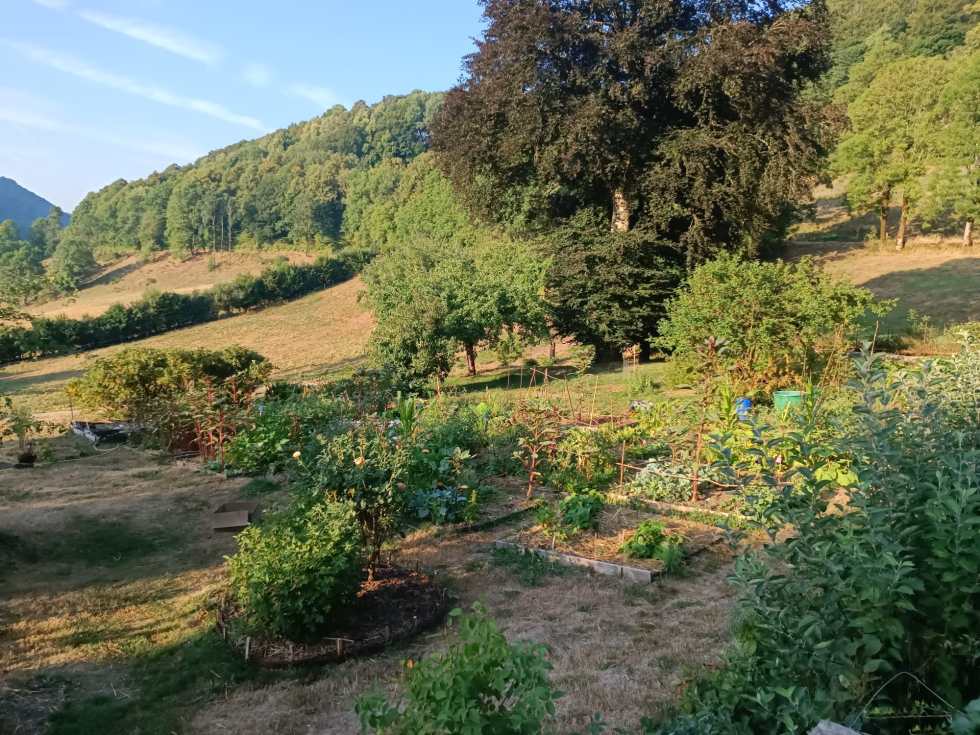
Allow me a final thought. Around food systems, the policy focus often lies in cities, especially as we are increasingly living in urbanized areas. The countryside is more often considered for agriculture, thus leaving the consumer and short distance out of the equation. However, a movement toward local production and historical knowledge through community gardens deserves to be brought to the countryside, too. Over the summer, I went WWOOFing in central France, where I had to care for the vegetable garden of an old castle. Just like in Hofstad, we would likely have starved from the harvest after France’s disastrous summer of heat waves. Though we had some excellent meals with freshly harvested garden produce, the wealth of knowledge and the sense of community we built over a week with the owner, other WWOOFers, and Ukrainian refugees living there are what will stick with me. So, is urban agriculture the solution to growing urban populations? I tend to say yes, but not as a solution to the provisioning issue — at least not in the near future. However, in particular when tapping into the historical roots of gardening, which are deeply engrained in European cities, urban agriculture can be an effective way to (re)build community in growing cities and raise awareness of the dysfunctionality of our current food system.
[1] Carolyn Steel, Hungry City: How Food Shapes Our Lives (Chatto & Windus, 2008); FAO, Rikolto, and RUAF, Urban and Peri-Urban Agriculture Sourcebook — From Production to Food Systems (FAO and Rikolto, 2022).
[2] Helmut Haberl et al., “A Socio‐Metabolic Transition Towards Sustainability? Challenges for Another Great Transformation,” Sustainable Development 19, no. 1 (2011): 1–14; Verena Winiwarter, “Approaches to Environmental History: A Field Guide to Its Concepts,” in People and Nature in Historical Perspective, ed. József Laszlovszky and Péter Szabó (Central European University Department of Medieval Studies & Archaeolingua, 2003); Gilles Billen et al., “History of the Urban Environmental Imprint: Introduction to a Multidisciplinary Approach to the Long-Term Relationships Between Western Cities and Their Hinterland,” Regional Environmental Change 12, no. 2 (2012): 249–53.
[3] Stepan Svintsov et al., “Integrating Agriculture into European Urban Landscapes Matters: A Systematic Assessment,” Sustainable Cities and Society 144 (2026): 107422. See also: Steffen Kriewald et al., “Hungry Cities: How Local Food Self-Sufficiency Relates to Climate Change, Diets, and Urbanisation,” Environmental Research Letters 14, no. 9 (2019): 094007. For a short summary: “Urban Agriculture Could Supply Around 28 Percent of Europe’s Vegetable Demand,” Leibniz Institute of Ecological Urban and Regional Development, 28 April 2026.
[4] Bas Paris et al., “Energy Use in Greenhouses in the EU: A Review Recommending Energy Efficiency Measures and Renewable Energy Sources Adoption,” Applied Sciences 12, no 10 (2022): 5150.
[5] Laura Prosperi, “Sull’utilità e il danno della storia nell’innovazione alimentare: note per una lettura dinamica del km zero,” in Filiera lunga / Filiera corta: Il cibo tra patrimonio e bene sociale, ed. Luca Mocarelli and Manuel Vaquero Piñeiro (Morlacchi Editore, 2025).
[6] Cécile Bruyet, “Wie appelen kweekt, die appelen eet. Toegang tot fruit in laatmiddeleeuws Antwerpen,” Madoc 38, no. 1 (2025): 1–11.
[7] Cécile Bruyet and Tim Soens, “Living Heritage at Hofstad: Teaching the History of Urban Farming with Hands in the Dirt,” Urban Agriculture Magazine 42 (2025): 12–14. See more on the project’s website: Hofstad | Hofstad | Universiteit Antwerpen.
*Cover Image: Urban farm and community garden “PAKT” in Antwerp. Photo by the author.
[Cover Image Description: Urban farm and community garden on the rooftop of a former industrial complex as part of an eco-neighborhood in Antwerp.]
Edited by Nina Foster; reviewed by Amanda Coate.


